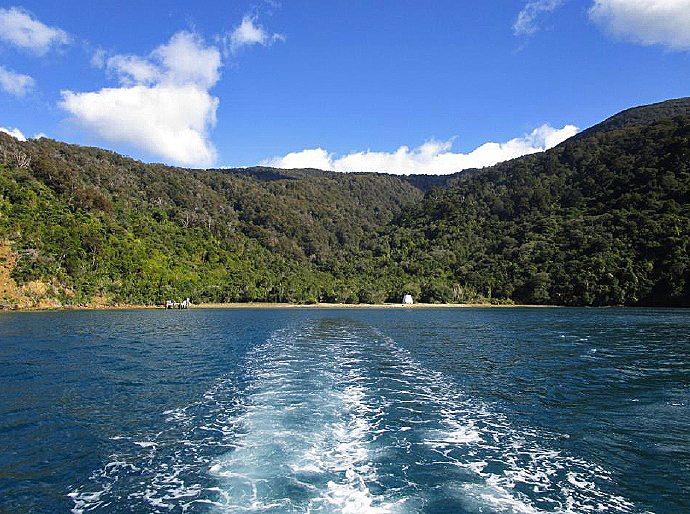
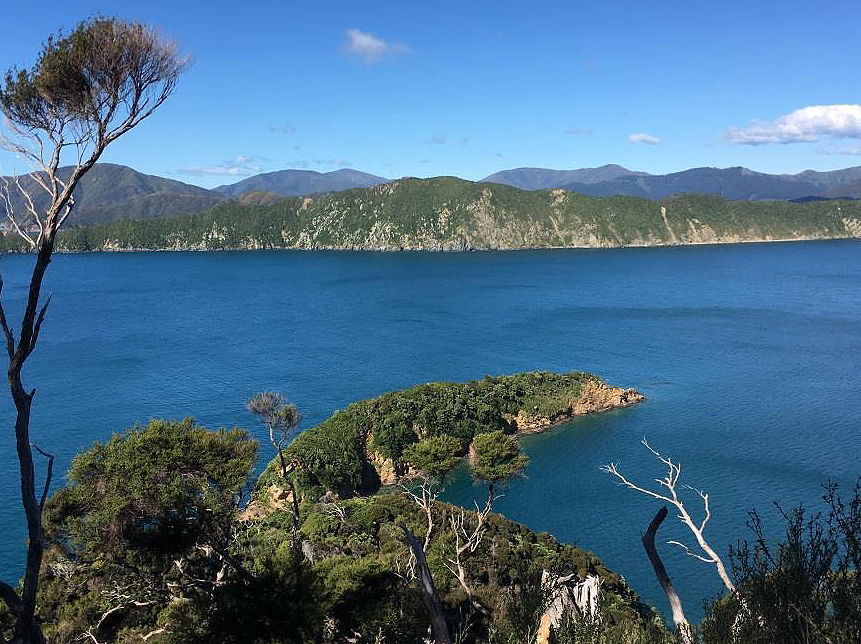
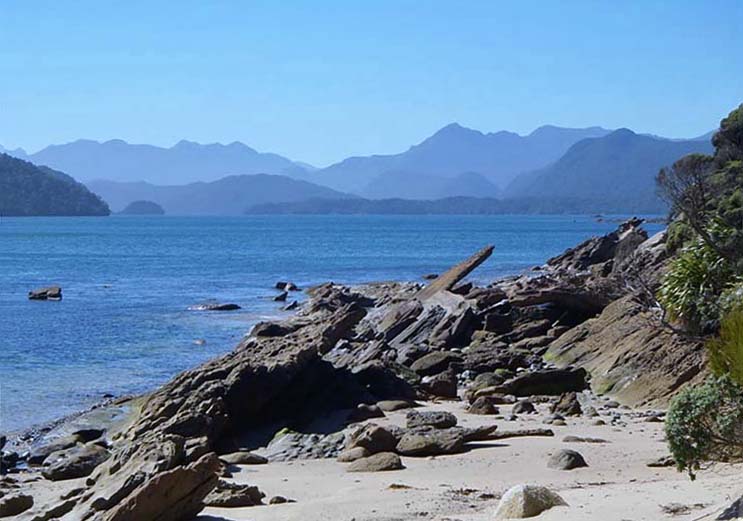
Meretoto/Ship Cove is a bay on the west side of Tōtaranui/Queen Charlotte Sound near its opening at Raukawa Moana/Cook Strait. Sheltered by the island of Motuara, it resides within Te Tau Ihu o Te Waka-a-Māui, the top of the Te Waipounamu/the South Island. In tribal narratives, Te Tau Ihu o Te Waka-a-Māui is the prow of the demigod Māui’s canoe, where he stood to fish up Te Ika-a-Māui/the North Island. The area’s place names are associated with the ancestor Kupe and his battles with the octopus Whekenui whom he finally killed at Arapāoa Island, so-named for the downward blow (‘arapāoa’) of his patu.
Tangata whenua
Migrants who traced their descent to the ancestral waka Kurahaupō landed in Tōtaranui in the centuries after Aotearoa was first settled (1250–1300 AD). It was the natural gateway between Te Waipounamu and Te Ika-a-Māui because the best route across the strait was between Tōtaranui and the southwest corner of the North Island, a relatively calm sea path guided by favourable north-westerly winds. Traders visited Tōtaranui on their way to and from the argillite quarries of Whakatū/Nelson and Rangitoto and the pounamu deposits further south. This path was also well-trodden by taua (war parties).
Tōtaranui’s flow of human traffic militated against stable occupancy by one tribal group. Beginning in the fifteenth century, major, successive tribal migrations from north to south occurred. In the late 18th century, Tōtaranui was controlled by Rangitāne, Ngāti Apa and Ngāti Kuia. Meretoto itself was one of the first places settled by Rangitāne when they migrated from Wairarapa the previous century. Small whānau groups occupied Tōtaranui’s bays on a seasonal basis and were sustained by fishing, hunting and gathering rather than horticulture, which required more settled conditions to flourish. There was no one dominant tribe in Te Tau Ihu and ‘fighting was never far away.’
New arrivals
On the morning of 15 January 1770, a large ship entered Tōtaranui and dropped anchor at Meretoto in the early afternoon. Captain James Cook (1728–1779) and the Endeavour had first made landfall at Tūranganui-a-Kiwa on the east coast of Te Ika-a-Māui in October the previous year, having sailed to Aotearoa from Tahiti. On board was the Ra‘iātean high priest Tupaia. He was able to converse with Māori because the languages were sufficiently similar and proved a crucial cultural go-between. This was the first European visit to Te Waipounamu since the brief, violent encounter between Dutch explorer Abel Tasman’s expedition and Ngāti Tūmatakōkiri at Mohua/Golden Bay in 1642 that left four Dutchmen and possibly one Māori man dead.
The Endeavour’s entry was observed by lookouts on Te Taonui-a-Kupe/Cape Jackson. The pā off the southern end of Motuara was crowded with people who had retreated there from nearby kāinga (villages) for safety. The Europeans arrived at a time of inter-tribal conflict and though word of them had already spread from the north, the people were sheltering from local enemies rather than the newcomers.
Science, exploration and empire
The purpose of Cook’s first voyage to the South Pacific (1768-71), jointly sponsored by the Royal Society and the Admiralty Department and driven by Enlightenment thought, was twofold: to observe the transit of Venus and to find Terra Australis Incognita, the fabled great southern continent first postulated by Classical Greek scholars. The hunt for Terra Australis continued on the second voyage (1772-75). On the third voyage (1776-80) they unsuccessfully searched for a north-west passage between the Atlantic and the Pacific. Driven by Great Britain’s imperialist motivations, strategic concerns were also at play as Cook assessed the natural resources and settlement potential of the new lands ‘discovered’.
Cook’s favourite anchorage
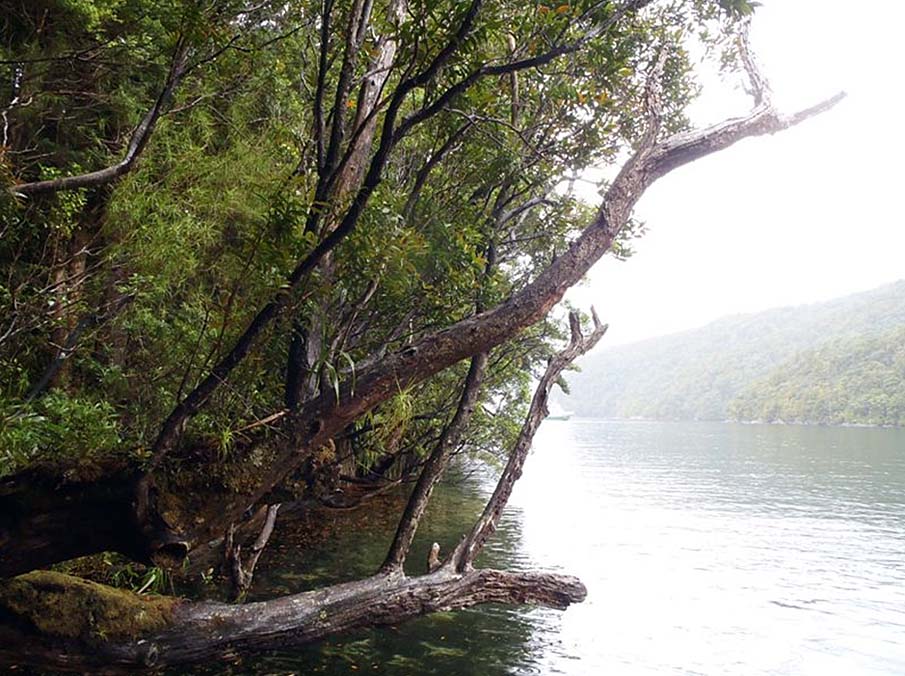
Cook anchored at Meretoto to careen the ship and obtain fresh provisions. It became apparent that the bay, which he dubbed ‘Ship Cove’, was an ideal base from which to rest the crew at shore camps, undertake scientific work and launch further explorations. It was sheltered by steep hills on three sides and Motuara offshore and the gently sloping sandy beach offered the perfect gradient for turning the ship on its side for repairs. There was plentiful fresh water and the seawaters were crowded with a variety of fish. The thick bush (‘one intire [sic] forest’) was a source of wood and birds good for eating, while plants that warded off the disease scurvy were abundant. The bay itself was not occupied in 1770 but people from nearby kāinga were keen to trade and the visitors were supplied with fresh and dried fish in addition to what their nets yielded. To these material benefits was added the sheer beauty of the cove, accentuated by what botanist Joseph Banks described as the birds’ ‘most melodious wild musick’ [sic].
Meretoto/Ship Cove was the only Aotearoa/New Zealand place visited each time over Cook’s three Pacific voyages, one of only two South Island sites visited and sole stop of the last voyage. The ships spent longer there than any other anchorage: 170 out of a total of 328 days in the country. On the last visit to Aotearoa/New Zealand in 1777 Cook called it ‘our old station’.
First voyage: one visit (1770)
On the Endeavour’s arrival, four waka launched from Motuara circled the ship. The occupants threw stones and offered verbal challenges before the rangatira Topaa indicated he wished to board. Tension was dispelled when Tupaia welcomed him with a hongi, which prompted the toa (warriors) on the waka to laugh loudly and join their leader. This incident foreshadowed the great esteem the people of Tōtaranui came to feel for Tupaia, a feeling replicated among iwi at other Aotearoa/New Zealand anchorages. It also highlighted his indispensability to the Europeans ̶ he was, as Cook wrote, ‘of infinite service’.
For Tōtaranui Māori, Tupaia was a living embodiment of their Polynesian origins. They spoke with him at length throughout his three-week stay, exchanging knowledge about shared roots and debating cultural practices such as kaitangata (cannibalism). When the Europeans returned in 1773, the first person asked for was Tupaia and there was widespread mourning when news of his death in late 1770 was shared, even among those who had not met him, and Ngāti Kuia composed a lament.
While the sailors were busy repairing the ship and Tupaia spoke with tangata whenua, Cook, his officers, the artists, and the scientists on board, led by Joseph Banks, explored the sounds. From a hill on Arapāoa Cook saw Raukawa Moana/Cook Strait, the first telling sign that Aotearoa/New Zealand was not part of a great southern continent and a discovery which provoked ‘high spirits’ in the normally restrained captain. Topaa and others confirmed the existence of the North and South Islands, which Cook later circumnavigated, providing final first-hand proof. On 31 January Cook raised the Union flag on Motuara and proclaimed British sovereignty over the Te Waipounamu/the South Island, having made the same declaration over what he now knew was Te Ika-a-Māui/the North Island at Te Whanganui-a-Hei/Mercury Bay the previous year. To Topaa, he merely said the pole was to show other ships that ‘we had been here before’.
The nascent relationship between Māori and Europeans was amicable but tested. Cook wounded a man who tried to snatch goods during trading, while another was killed by an officer who feared attack after interfering with a tapu site. It is likely that venereal disease was introduced into the local population. In the days before the Endeavour left on 6 February, Tōtaranui Māori had tired of their resource-hungry visitors and refused to sell any more fish.
The second voyage: four visits (1773-1774)
During the first voyage, Cook conclusively demonstrated that Aotearoa/New Zealand was not part of Terra Australis but the continent’s existence was neither proved nor disproved. Settling this question was the primary purpose of the second voyage undertaken by two ships, Cook’s Resolution, and the Adventure, captained by Tobias Furneaux. By early 1774 it was clear the continent was not in the South Pacific.
The ships spent 133 days over four visits at Meretoto/Ship Cove between 1773 and 1774:
• Visit one: Adventure 6 April–7 June 1773 and Resolution 18 May–7 June 1773
• Visit two: Resolution 3–25 November 1773
• Visit three: Adventure 30 November–22 December 1773
• Visit four: Resolution 18 October–10 November 1774.
Relationships became tense during these visits. Repeated theft of European goods was likely muru (ritual confiscation), given the amount of natural resources the visitors were consuming without permission, and the ships’ rowboats were chased by waka on a number of occasions. On 17 December 1773, 10 of the Adventure’s crew rowed to Wharehunga Bay on Arapāoa to cut grass for the ship’s livestock and never returned. The following day a search party discovered their fellow crewmen had been killed, dismembered, cooked and partially eaten. The Adventure left for good four days later. When the Resolution returned almost a year after, Cook dismissed vague rumours about the killings.
The third voyage: one visit (1777)
The Resolution and the Discovery (captained by Charles Clerke) arrived at Meretoto/Ship Cove on 12 February 1777. They stayed two weeks before heading for North America to search for the north-west passage.
Cook learned more about the 1773 killings. The rangatira Matahoua told him seaman Jack Rowe opened fire on a group of Māori, killing two, after bread was stolen from the rowboat. Another informant said the Ngāti Kuia rangatira Kahura, who appeared to be the principal protagonist on the Māori side, was hit on the head after taking items from the boat, a serious breach of tapu requiring utu (retaliation) for reasons of mana. Regardless of the exact circumstances, the Europeans were outnumbered and all were killed in the ensuing violence.
For his time, Cook was relatively respectful in his attitude towards indigenous peoples and tried to avoid violence. During this final visit he did not retaliate, instead inviting Kahura into his cabin and having his portrait sketched. This approach pleased few. Cook’s esteem fell among his crew and he suffered a loss of mana with Māori as they expected him to avenge the killings.
When the ships left on 26 February, the youths Te Weherua and Koa, whose whānau had engaged in much trading with the Europeans, were on board the Resolution. On reaching the Cook Islands, they likely became the first Māori to voyage from Aotearoa/New Zealand to other Pacific islands in many hundreds of years and conceivably ever, if the first migrants did not make return journeys.
Science
The intellectual aims of the voyages attracted an array of scientists and observers whose activities at Meretoto/Ship Cove constitute some of the earliest European scientific endeavours in Aotearoa/New Zealand. The long stays allowed for systematic and extensive work. During the first visit, botanists Joseph Banks and Daniel Solander ‘nearly exhausted all the Plants’ and had great success collecting mosses. Naturalists Johann and Georg Forster and Anders Sparrman collected and described numerous birds and fish on the second voyage visits.
Significant activity occurred in the field of astronomy. Cook and Charles Green made astronomical observations from the Endeavour to calculate latitude and longitude for navigation and mapping purposes, but this work was stepped up on subsequent voyages with the aid of chronometers, which kept accurate time at sea. Astronomer William Bayley of the Adventure set up an observatory in a whare (house) at the now-abandoned pā off Motuara in April 1773, while William Wales erected a tent observatory at the bay when the Discovery arrived the following month. Over the five visits of the second and third voyages, latitude and longitude calculations were refined to the extent that ‘the position of Ship Cove was better established than almost any other place on the surface of the Earth’ including Greenwich, home of the Royal Observatory. In 1770 Cook made an important contribution to geology with the country’s first measurement of magnetic declination (difference in angle between geographic and magnetic north) made at Meretoto/Ship Cove.
Trading
Mutually-advantageous trading facilitated interaction between Māori and Europeans at Meretoto/Ship Cove. In 1770 Tōtaranui Māori were impoverished by constant conflict and the only commodity they were willing and able to part with was fish, in return for nails and cloth. Though most of the Europeans viewed cannibalism with horror, human bones were sought-after curios. On this first visit Joseph Banks became the first European to acquire a mokomōkai (preserved tattooed head).
Europeans were incorporated into Tōtaranui’s existing function as a trading centre. The opportunity to acquire valuable European goods attracted Māori traders from Te Ika-a-Māui/the North Island and Ngāi Tahu from other parts of Te Waipounamu/the South Island during the second and third voyage visits, and they set up camp there. These traders were more affluent than Tōtaranui Māori and had a wider range of goods to trade, including pounamu, which was so sought-after ‘that there was hardly a thing [Europeans] would not give for a piece of it.’
Production of pounamu artefacts for the European market increased dramatically between 1773 and 1777, and manufacturing was supplemented by items acquired through warfare. Almost all the Cook-era pounamu artefacts that found their way into museum collections were acquired at Meretoto/Ship Cove and environs.
Nails remained the most desirable European commodity, joined by Tahitian tapa cloth (second voyage) and hatchets (third voyage). The provision of sexual services to the Europeans became more formalised from 1773, with Māori men controlling a trade previously provided informally by women.
Animals and plants
European animals and plants were first introduced during the second voyage visits. Gardens were planted on Motuara and other islands in the Sound and hens, pigs, sheep and goats were released into the bush. The sheep and goats did not take to their new home. To Cook’s dismay, the first pair of sheep ever released in Aotearoa/New Zealand were found dead three days later after eating poisonous plants, his ‘hopes of stocking this country with a breed of sheep…blasted in a moment’. The male goat ran into the sea twice before disappearing, having likely drowned, leaving the female with no mate. The hen and pig releases were successful and both established breeding populations. Many of the gardens had disappeared by 1777 but plants like potatoes were incorporated into local horticulture and spread throughout the Te Waipounamu/the South Island from Tōtaranui.
Artistic and written records
Artists were present on all three voyages and their depictions of Meretoto/Ship Cove, Tōtaranui and the area’s people are among the earliest pictorial records of Aotearoa/New Zealand. Cook and a number of officers kept journals recording daily activities and interactions with Māori. These, along with maps, charts, ship logs and te reo vocabularies, are detailed records of sustained cross-cultural interactions.
The Endeavour works depict peoples meeting for the first time, and in the case of Tupaia, reuniting after centuries of separation. Records from subsequent voyages chart Māori communities incorporating the visitors into their lives. While European artworks and diaries are inevitably inflected with their creators’ biases and imperfect understanding, they provide a record of life in Tōtaranui prior the so-called ‘musket wars’ period of the late 1820s and early 1830s which mark the arrival of Te Ātiawa and Ngāti Toa.
Later visitors
These records put Meretoto/Ship Cove on the world map and alerted Europeans at home to its existence, though subsequent visits did not begin until around 1810, when sealers and whalers anchored there. Primed by the journals, later European visitors saw themselves as following in Cook’s footsteps. The Russian polar expedition led by Fabian von Bellingshausen rested in and around Meretoto/Ship Cove for twelve days in 1820 and the officers regularly referred to the Cook records and made use of the vocabularies. When the New Zealand Company’s Tory anchored there for two weeks in 1839, company agent William Wakefield noted they occupied ‘nearly the same position as Captain Cook’. Tōtaranui Māori were aware of European interest in the Cook visits. When the survey vessel Acheron stopped there in 1850, the party was asked if they wanted to see a tree Cook tied ships to.
Commemoration
In line with growing interest in Aotearoa/New Zealand history and its European ‘founders’ sparked by 50th jubilee events, over 2,000 acres of thick forest around Meretoto/Ship Cove was reserved ‘in memory of its occupation by Captain Cook’ in 1896. Meretoto/Ship Cove was the first site reserved by the government for its historic significance and predated the Scenery Preservation Act 1903, the first law specifically passed to protect places of scenic and historic value.
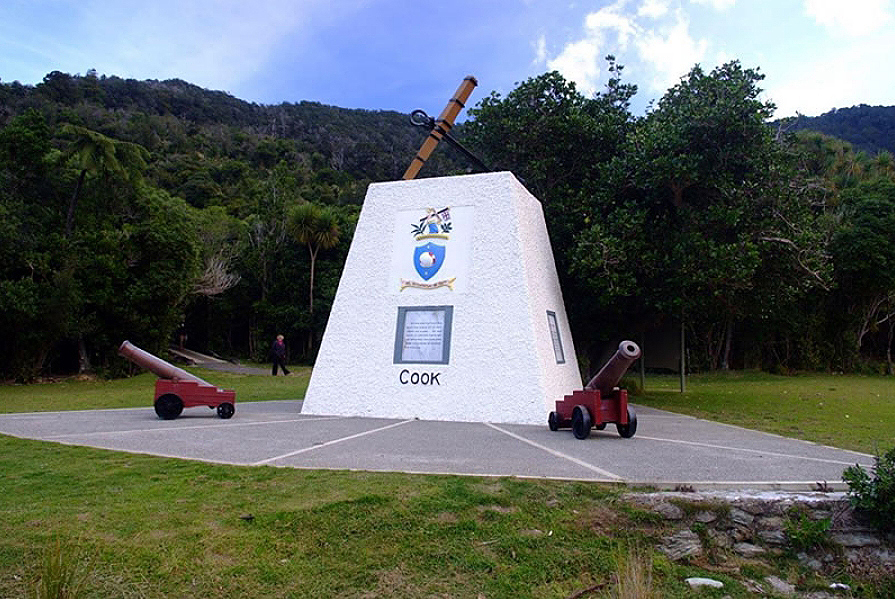
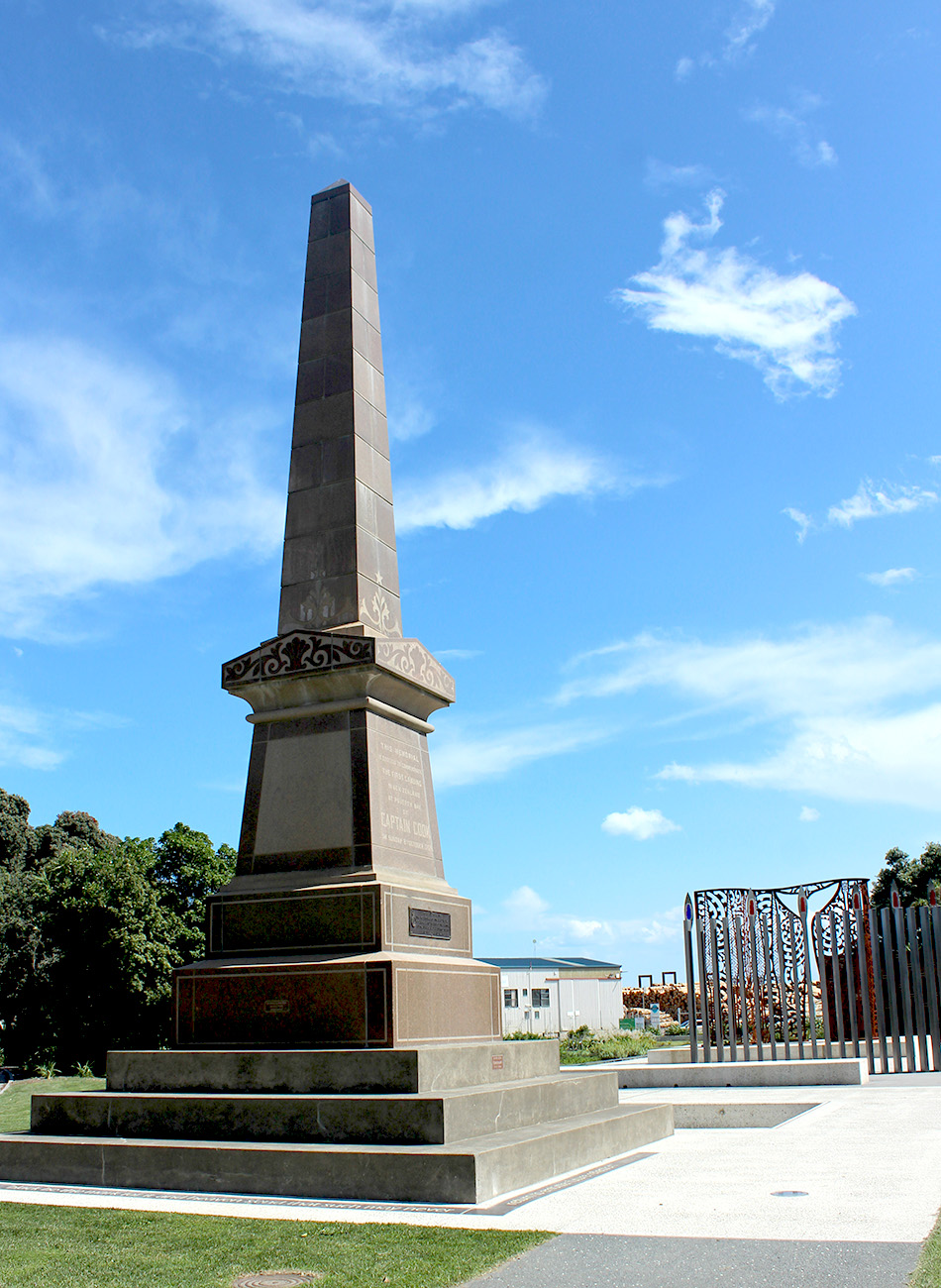
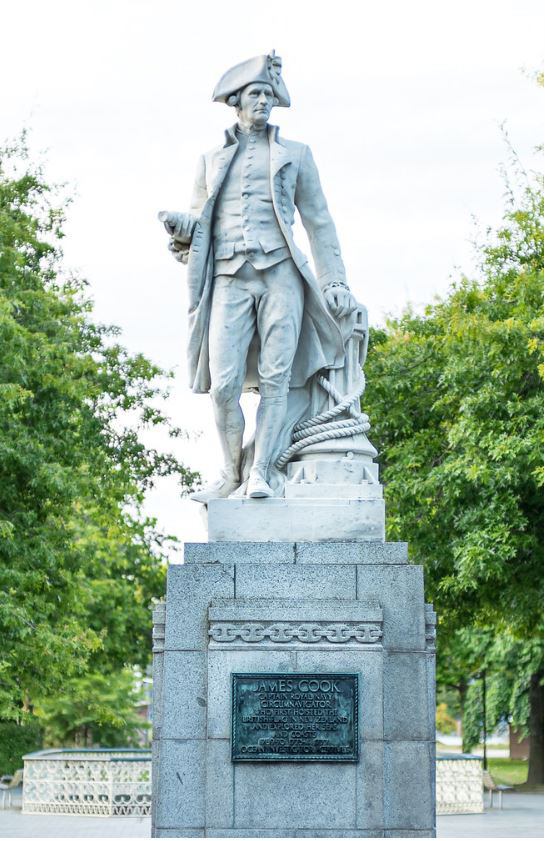
The scenic and historic attractions made it a visitor destination from the late nineteenth century. In 1906, about 550 people attended the Blenheim Rifle Company’s summer picnic at the bay and a Cook memorial was the topic of conversation over lunch. After seven years planning and fundraising by a Marlborough committee, a large concrete monument was unveiled by the Governor Lord Liverpool before a crowd of 2,000 on 11 February 1913. It was the country’s second Cook memorial, having been preceded by the obelisk erected at the 1769 landing site at Gisborne in 1906. Another Cook monument was installed on Motuara in 1920.
In 1970, the bicentenary of the Endeavour’s arrival at Meretoto/Ship Cove was commemorated by an elaborate re-enactment repeated two months later for a royal visit by Queen Elizabeth II. In 1996 an Endeavour replica re-enacted the arrival alongside the Te Awatea Hou waka representing the iwi of Te Tau Ihu. Ten years later, the Department of Conservation (DOC) in partnership with iwi redeveloped the site to better reflect its bicultural significance and acknowledge mana whenua. This included the installation of a free-standing pouwhenua, a bridge with two pouwhenua, one representing the Kurahaupō iwi (Rāngitane, Ngāti Apa and Ngāti Kuia) and the other representing Te Ātiawa; a visitor shelter, seating, tables and interpretation panels. Meretoto/Ship Cove became one of the first DOC Icon cultural heritage sites in 2006/07. In 2020, the 250th anniversary of the encounters will be commemorated through events organised the community-led Tōtaranui 250 Trust.